When to Check “Yes” on Virtual Currency Question on Tax Form
Taxes. Everyone loves to hate them. But no matter what you do, you can’t avoid the taxman. Tax dislike is especially true in the burgeoning world of cryptocurrencies, where the IRS continues to change and update its guidance on crypto-related taxes.
Beginning in the 2020 tax year, the IRS has placed a question at the top of every 1040 tax return. Knowing how to answer this question correctly is very important for cryptocurrency advocates who want to avoid the added scrutiny of an IRS audit.
The Question
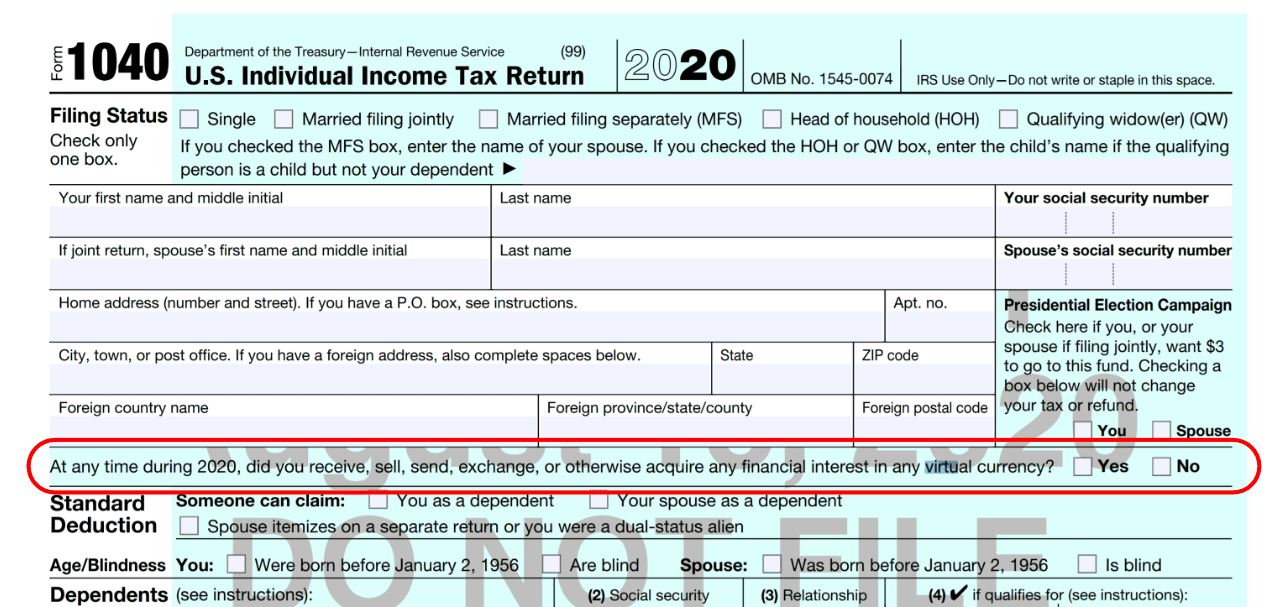
The IRS introduced this crypto-related question on its 2019 Form 1040, and the 2020 version of the form will have the same exact question, but this time it appears on the first page of the document. The question, as seen in the screenshot below, asks:
“At any time during 2020, did you receive, sell, send, exchange, or otherwise acquire any financial interest in any virtual currency?”
In short, the IRS wants to know if, at any time during the previous year, you bought or sold cryptocurrency. It sounds like a simple question, right? Unfortunately for cryptocurrency holders, there is much more complexity to this question than you might think.
The Problems
While the IRS’s cryptocurrency question may seem simple, it really isn’t. Yes, the agency has answered several cryptocurrency-related questions for consumers on its website, but many scenarios and instances complicate this question.
Here are some scenarios that might leave you wondering how to answer the IRS’s question:
Holding cryptocurrency in 2020 but not placing any trades over the course of the year
Buying cryptocurrency in 2020 but not selling any
Transferring crypto from one wallet to another
Receiving tokens from an unexpected hard fork or airdrop
Buying cryptocurrency on behalf of someone else
Receiving cryptocurrency for services rendered
Paying for goods or services with cryptocurrency
Trading one cryptocurrency for another
Luckily, the IRS published updated instructions for Form 1040, and within it gave slightly more guidance to this question about cryptocurrency activity. This guidance now states that a cryptocurrency transaction includes any of the following:
The receipt or transfer of virtual currency for free, including from an airdrop or hard fork
An exchange of virtual currency for goods or services
A sale of virtual currency
An exchange of virtual currency for other property, including for another virtual currency
A disposition of a financial interest in a virtual currency
If at any time in 2020 you were engaged in any of these activities, according to the IRS you must answer yes to the cryptocurrency question. Note that simply having held cryptocurrency over the year without taking any of these actions is omitted, and therefore does not require you to answer yes on Form 1040.
What if you answer wrong?
The IRS has made it clear it isn’t messing around with cryptocurrencies. In 2019 it sent more than 10,000 letters to cryptocurrency holders warning them that they may have committed tax fraud. The agency has also reportedly been hiring more cryptocurrency tax professionals to assist with crypto-specific audits.
Checking no incorrectly on this question could come back to haunt you. Even if this is just an unintentional error, the IRS sees a wrong answer to this question as a direct failure to report cryptocurrency activity. This could lead to financial penalties and criminal prosecution as well, and with it, the potential for prison time.
According to Matt Metras of MDMFinancial Services, when in doubt, check yes.
“This is an easy question that should have an easy answer but doesn’t. The form 1040 instructions imply that you only buy and/or hold crypto, you do not need to check yes. However, the instructions and the form itself contradict each other. The form says, “At any time during 2020, did you receive, sell, send, exchange, or otherwise acquire any financial interest in any virtual currency?” If you were to buy crypto, it is unlikely you are not subsequently receiving it or acquiring a financial interest in it. To further complicate matters, different IRS officials have publicly given conflicting statements on this issue.
My advice is if there’s any doubt, the potential issues of checking “yes” are much smaller than checking “no.””
What do you do?
You might think that the IRS will never know if you answer this question incorrectly, but you couldn’t be more wrong. Metras quickly dispels this myth:
“Falsely answering this question would be considered perjury and can create a criminal liability issue. Secondly, some exchanges provide information to the IRS. The IRS won’t say which ones or what information is submitted. Also, even if the exchanges you use don’t cooperate with the IRS now, it’s possible they will before the statute of limitations on your return expires. Lastly, if you ever want to convert that crypto back into fiat, you’re going to want to have an established basis to avoid being taxed on the full amount.”
Therefore, you need to take the appropriate steps to ensure you are ready for the IRS’s cryptocurrency question and related reporting. Here’s how you can get prepared for crypto tax season now and in the future:
Keep records – To ensure you have all of your bases covered, keep detailed records of all of your cryptocurrency activity each year.
Software can help – Various software tools can help you organize your cryptocurrency transactions and determine your tax exposure. These tools can be useful but won’t be foolproof, especially for active traders.
Consult a tax specialist – In the end, you want to work with someone who has an in-depth understanding of cryptocurrency tax law. Consulting a cryptocurrency tax specialist will save you the time and stress of determining how to handle your crypto taxes best.
BitIRA has partnered with some of the industry’s best tax specialists who can provide you guidance and support this tax season. Check out this list of CPA advisors who specialize in cryptocurrency in your area to get more support in your cryptocurrency-related tax questions.