For years, cryptocurrency has been described as an alternative to government-controlled money.
Now, the U.S. Treasury Secretary is making a rather different argument: Crypto could help the dollar maintain its position as the world’s dominant currency.
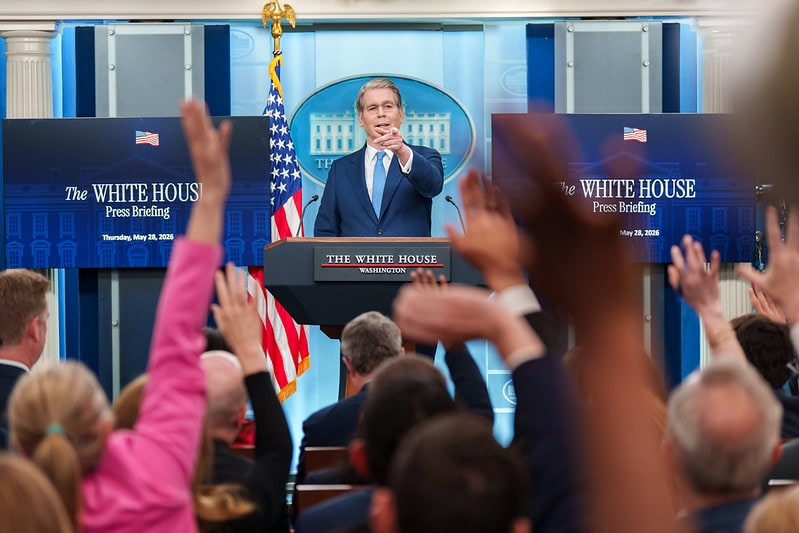
That’s what Treasury Secretary Scott Bessent suggested on October 27, during a conversation with Ripple CEO Brad Garlinghouse at Ripple’s Swell conference.
According to CoinDesk, Bessent argued that technological leadership will increasingly influence which countries maintain their economic power.
Historically, he explained, military strength has helped support the world’s leading currencies. But technological leadership, including artificial intelligence, semiconductors and digital financial infrastructure, is becoming increasingly important.
Bessent predicted that American leadership in digital assets would continue to strengthen the dollar.
That’s an interesting development, particularly for an industry whose early supporters often emphasized independence from governments and traditional financial institutions.
But there’s an important distinction here. Bessent isn’t suggesting that Bitcoin or another cryptocurrency will replace the dollar. He’s describing how digital assets could help extend the dollar’s global reach.
And the key to understanding that possibility is a particular category of cryptocurrency: stablecoins.
How crypto could strengthen the dollar
Stablecoins are digital assets designed to maintain a relatively stable value, typically by tracking an established currency such as the U.S. dollar.
Unlike Bitcoin or Ethereum, whose prices can fluctuate dramatically, a dollar-backed stablecoin generally aims to remain worth approximately $1.
That stability isn’t guaranteed. It depends on factors including the issuer’s financial reserves, redemption arrangements and the functioning of the markets involved.
Nevertheless, dollar-backed stablecoins have become an important part of the cryptocurrency ecosystem.
In August 2026, the International Monetary Fund (IMF) reported that nearly 99% of stablecoins were denominated in U.S. dollars.
Now, consider what happens when someone outside the United States uses a dollar-backed stablecoin.
Instead of obtaining physical dollars or opening a dollar-denominated bank account, that person may be able to acquire and transfer a digital token representing dollar-denominated value.
The transaction takes place using blockchain technology, but the underlying currency reference remains the U.S. dollar.
In other words, cryptocurrency technology can provide another way to access and use dollars, rather than an alternative to them.
And that could have important implications for the dollar’s international role.
Why the Treasury Department is interested
Here’s where the story gets particularly interesting.
Many dollar-backed stablecoin issuers hold reserves consisting largely of short-term U.S. Treasury securities and other liquid dollar-denominated assets.
Treasury securities are debt obligations issued by the federal government to finance its operations.
When someone acquires newly issued stablecoins, the issuer may need to purchase additional reserve assets to back those tokens. When those reserves include Treasury securities, expanding stablecoin issuance can create additional demand for U.S. government debt.
Treasury Secretary Bessent has emphasized this possibility before.
In July 2025, following the enactment of the GENIUS Act, Bessent described stablecoins as a way to expand international access to dollars and increase demand for U.S. Treasuries.
There’s evidence that this relationship already matters.
Research published by the Bank for International Settlements examined how flows into and out of dollar-backed stablecoins affect short-term Treasury yields. Its findings suggest that stablecoin activity can influence demand and pricing in that market.
Still, there’s a distinction between creating additional demand for dollars and simply moving existing dollar holdings into a different financial product.
And while stablecoins have expanded considerably, much of their activity still occurs within cryptocurrency markets rather than everyday commercial payments, according to the IMF.
So stablecoins have the potential to reinforce the dollar’s international influence. How much they ultimately contribute remains an open question.
Washington is doing more than talking
Bessent’s remarks are especially noteworthy because they’re accompanied by a significant change in the regulatory treatment of stablecoins.
The GENIUS Act, signed into law on July 18, 2025, established a federal regulatory framework for payment stablecoins.
Then, on October 21, 2026, the Office of the Comptroller of the Currency announced a final rule implementing important portions of that law.
The rule establishes requirements covering such matters as reserve assets, redemption, risk management and regulatory supervision for issuers under the OCC’s jurisdiction.
The final rule and the GENIUS Act are scheduled to take effect on January 18, 2027. Other aspects of the regulatory framework, including certain anti-money-laundering requirements, remain subject to separate rulemaking.
You can review the OCC’s announcement here.
This distinction matters.
We’re no longer discussing only whether policymakers find cryptocurrency technology interesting. Federal regulators are establishing rules for how certain digital assets can operate within the financial system.
Those rules may provide greater clarity for businesses and customers. But regulatory oversight doesn’t eliminate all risks.
And the framework specifically addresses payment stablecoins. It’s hardly a blanket government endorsement of every cryptocurrency. Still, to me, it’s a pretty big deal!
What does this mean for other cryptocurrencies?
Here’s a question that anyone interested in cryptocurrency investing might reasonably ask:
If stablecoins are becoming more important to the financial system, does that make bitcoin, Ethereum and other cryptocurrencies more valuable?
Not necessarily. Stablecoins and other cryptocurrencies can serve very different purposes.
Dollar-backed stablecoins are generally designed for price stability and transactions. Bitcoin and ether have different characteristics, use cases and sources of market demand. So increased stablecoin adoption doesn’t automatically translate into greater demand for either asset. Nor does it establish that cryptocurrencies are reliable inflation hedges like gold.
As we’ve discussed previously, cryptocurrencies and precious metals have different characteristics and may behave quite differently under changing economic conditions. Frankly, we still don’t have enough historical data in place to really get a handle on crypto’s correlations with other asset classes.
There’s also a larger point worth remembering.
According to the Federal Reserve, the dollar’s global position rests on several longstanding advantages, including the size of the U.S. economy, the depth and liquidity of American financial markets, and confidence in U.S. institutions.
Blockchain technology can provide another channel for using dollars worldwide. But it cannot, by itself, guarantee continued dollar dominance.
A different way to think about crypto’s future
For retirement-minded investors, the significance of Bessent’s comments isn’t that Washington has discovered the next great investment.
It’s that digital assets are increasingly being considered as part of the infrastructure of modern finance, rather than simply as an alternative to it.
That’s a meaningful change in how policymakers approach cryptocurrency technology.
It doesn’t settle the debate over the long-term value of individual cryptocurrencies. It doesn’t remove volatility, regulatory uncertainty or investment risk.
But it does provide another reason to distinguish cryptocurrency’s actual financial uses from the speculation that so often dominates headlines.
That distinction matters for long-term crypto investors. So do objectives, investment time horizon, tolerance for volatility and the role of cryptocurrency within broader retirement savings. BitIRA helps everyday American investors own cryptocurrencies within self-directed retirement accounts. These accounts offer tax treatment based on the type of IRA: traditional IRA withdrawals are generally taxable, while qualified Roth IRA distributions are tax-free.
If you’re interested in learning how a Digital IRA works, including the available options and considerations involved, download our free Essential Guide to Digital IRAs. And if you’ve completed your due diligence and are ready to get started, you can open a Digital IRA with BitIRA right now – online – in less than 10 minutes.
