Artificial intelligence making bold bitcoin price predictions is hardly new. But when Elon Musk’s Grok AI constructs a detailed hypothetical that could theoretically send bitcoin into uncharted territory before January 1, 2027, it’s worth slowing down to examine what the model actually modeled – and where the limits of that exercise sit.
The scenario Grok built centers on a sweeping institutional shift: Imagine the world’s most powerful central banks, among them at least one from the G7 alongside several large emerging-market players, jointly announcing that bitcoin would hold official reserve status on par with gold.
In this setup, those institutions would lay out structured buying plans, funnel a share of their reserves into bitcoin and establish new settlement systems. In effect, officially recognizing bitcoin as a borderless, politically neutral asset. Exactly as Satoshi intended!
Stack those conditions together and you can see why Grok flagged the scenario as an extreme edge case.
What Grok actually said – and what it didn’t
Before we go any farther, here’s the specific scenario:
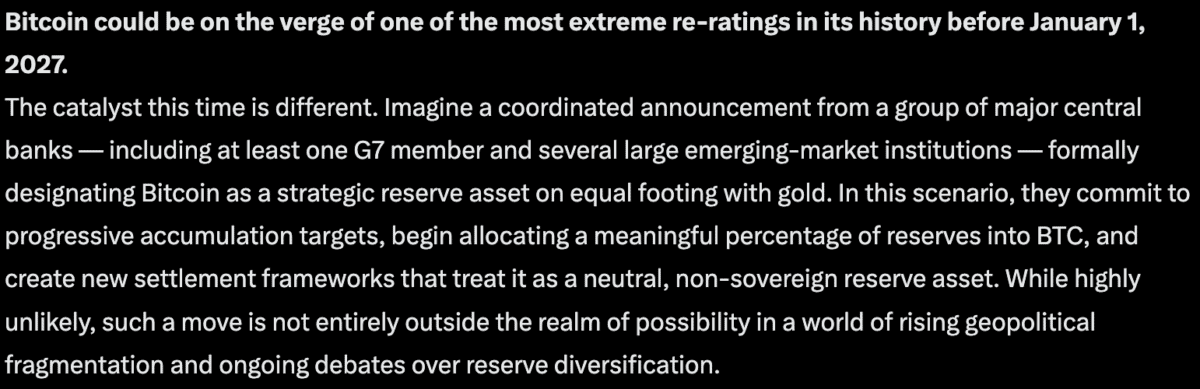
Note the AI (er, forgive me, the superintelligence) was careful to characterize this setup as a low-probability outcome, though not an inconceivable one. Consider the current environment of geopolitical realignment and widening debates about the dollar’s dominance in global reserves. The historic wave of central bank gold-buying that began in 2022, culminating in gold surpassing U.S. government debt as a share of central bank reserves.
That framing matters! Grok wasn’t predicting this would happen, rather it was pricing the outcome if it did. Remember, too, that central banks are mostly skeptical of cryptocurrencies as reserve assets.
Under that extreme scenario, the model estimated bitcoin’s price could land somewhere in the $350,000-$500,000 range, with an outer limit approaching $650,000 or beyond. By the first day of 2027!
Grok was explicit that this represents a probability-weighted bullish outlook rather than a “confident projection.” Obviously, the actual trajectory would depend on macroeconomic conditions, available liquidity and measures of broader risk appetite.
Don’t overlook these qualifications! Generating a scenario and then estimating its price implications is a structured thought experiment, not a market call backed by predictive evidence. So let’s take a look at where we are today…
Where bitcoin actually stands right now
Setting aside the hypothetical, bitcoin’s real-world technical picture tells its own story. At the time I’m writing, bitcoin is changing hands near $78,000, having clawed back some key short-term moving averages after a sell-off that followed U.S. midterm elections. Bitcoin’s all-time high remains over a year in the rearview mirror at about $126,000. Today, the market is spending recent weeks consolidating just below $80,000.
When I look at the bitcoin price chart, I see a constructive weekly structure – each pullback finding support at a higher level than the last. Trading volume picking up on the rallies, and price holding above a demand zone that formed earlier in 2026. I think the $95,000-$100,000 boundary is the critical test. Clearing and holding above that range would signal broader upward momentum, a possible set-up for a run into territory beyond any prior peak.
That’s just the price chart talking. None of it depends on central banks doing anything surprising. It simply reflects where the market is positioned today on its own terms.
Why central bank adoption matters (no matter how unlikely)
The Grok scenario is hypothetical, but the underlying concepts are not. The U.S. government has taken early steps toward establishing a bitcoin strategic reserve. Discussions about reserve diversification are genuinely happening in a number of nations navigating dollar dependency and geopolitical exposure. Earlier this year, we saw pensions considering crypto exposure.
Central banks and pension funds manage hundreds of billions of dollars. They’re the true whales of the investment world – deploying assets at a scale that really does ripple noticeably around the world. That’s one of the reasons that the decision of a Danish pension fund to sell its U.S. federal debt was a big deal.
See, what Grok’s model is essentially describing is a demand shock at institutional scale – the kind of sudden, structural buying that would far outpace available supply. This would drive the price of any asset up, particularly given bitcoin’s hard cap of 21 million coins. When you frame it that way, the price math becomes less outlandish.
For retirement-focused investors thinking about bitcoin not as a short-term trade but as a long-term holding, this kind of analysis is worth understanding. But not because the forecast will come true, rather because it illustrates the asymmetric nature of bitcoin’s potential demand relative to its fixed supply. As Lyn Alden explained when comparing gold to bitcoin, the global supply of gold is not fixed. It grows at about 1.5% a year – incredibly slowly compared to most financial assets, especially commodities contracts, where trillions of dollars in notional value can be created in moments.
Like gold, bitcoin’s supply-demand structure is part of what attracts long-term investors in the first place. And it’s a plausible reason institutional investors like central banks and pension funds would consider bitcoin specifically (vs. crypto generally) as a diversifying asset.
The difference between a forecast and a plan
There’s an important distinction between finding a forecast intellectually interesting and treating it as a basis for financial decisions.
AI models can synthesize historical patterns, construct internally consistent scenarios and generate probability-weighted outcomes. What they cannot do is account for the full range of unknowns. Think for a moment about all the things that could go wrong: Regulatory reversals, liquidity crises, technological failures like the recent Binance hack… Or simply the unpredictable behavior of millions of speculators, traders, investors and money managers.
One thing Grok didn’t mention in the extract we examined above: Bitcoin has also demonstrated its capacity for severe drawdowns. Regardless of the circumstances, the journey from $80,000 to $650,000 is not a straight line. The same volatility that fuels rapid surges under favorable conditions produces equally sharp losses when conditions turn unfavorable.
With crypto, factors like time horizon, risk tolerance and overall portfolio context matter enormously! Exactly, I believe, as they do with every investing decision.
For those interested in diversifying with bitcoin for the long haul, the tax structure of a Digital IRA is a great advantage. Gains inside a Traditional IRA are tax-deferred, meaning you pay taxes on investment gains during your retirement withdrawals. A Roth IRA structure generally allows for tax-free growth under applicable conditions – in other words, qualified withdrawals in retirement are tax-free. An ideal home for high-growth-potential assets like crypto generally (and bitcoin specifically).
To be clear, no IRA structure eliminates the market risk of assets. Regular readers know I love to remind everyone that, in investing, risk and reward are joined at the hip. That’s what makes diversification so important.
Thinking long-term about a long-volatility asset
If a Grok scenario gets you curious about what diversifying your savings with bitcoin could do for your future – not because an AI told you to, but because you want to understand the mechanics – BitIRA is built to help with exactly that question. BitIRA helps eligible customers to open a Bitcoin IRA with dedicated security and custody arrangements designed for digital assets. That’s in addition to BitIRA’s “end-to-end” insurance that protects your assets in transit or in storage.
Our free Essential Guide to Digital IRAs is a good starting point for anyone interested in how digital assets can play a role in a retirement strategy alongside conventional asset classes. The guide walks through how a Digital IRA works, what to consider before opening one, and what documentation and eligibility requirements apply. If, on the other hand, you’ve completed your due diligence and are ready to take the next step, you can open a Digital IRA with BitIRA online right now (anytime, day or night) in less than 10 minutes.
Forecasts are worth reading for the scenarios they present. The decisions that follow from them are still yours to make. Make your decision with eyes open to both the upside and the uncertainty baked into every projection. This isn’t investing advice, by the way – this is life advice from someone who’s made a lot of mistakes! And, I hope, learned my lesson every time.
